
Executive Summary
- Why AI agents are becoming the primary way consumers discover and buy products
- What Amazon’s Rufus is doing with $10B in annualized sales and 250M users
- How Klarna’s AI is now autonomously processing refunds, returns and purchases
- What Google, OpenAI and Shopify launched in the last 90 days that changes everything
- Why only 8% of product listings are ready for AI-driven recommendations
- What small businesses need to do right now to stay visible to AI agents
On January 11, 2026 at the National Retail Federation conference, Google announced the Universal Commerce Protocol, an open standard that lets AI agents complete purchases directly inside Search, Gemini and other AI platforms. OpenAI rolled out the Agentic Commerce Protocol with Stripe so ChatGPT can execute transactions. Shopify made Agentic Storefronts available to millions of merchants in March so products get surfaced natively inside AI conversations and Klarna joined both Google’s UCP and the Agent Payments Protocol to become infrastructure for AI-driven payments.
Amazon said on their Q3 2025 earnings call that their AI shopping assistant Rufus is on pace to generate $10 billion in incremental annualized sales, has 250 million users and customers who use it are 60% more likely to complete a purchase. Amazon Q4 2025 data put Rufus active users at 300 million with roughly $12 billion in annualized sales. On November 18, 2025 Amazon rolled out autonomous features so Rufus can now purchase products on behalf of customers when they hit a target price, track prices for 30 to 90 days and handle post-purchase support including order tracking and returns without any human involvement.
Klarna’s AI assistant, which OpenAI has publicly featured, handles refunds, returns, payment disputes, cancellations and invoice corrections autonomously across 35 languages in 23 markets. It’s doing the work of 700 full-time agents and saving Klarna around $60 million in operational costs according to their reporting.
A big question your business should be focused on: When a customer asks ChatGPT, Gemini, Perplexity, Rufus or any other AI assistant for a product or service recommendation in your category, does your business show up or does your competitor?
Change Is Happening Quietly
For the past twenty years, being found online meant ranking on Google and businesses spent billions optimizing for search engines, building backlinks, targeting keywords and trying to get on page one.
IBM’s Institute for Business Value found that 45% of consumers already use AI for at least part of their buying journey. 58% have replaced traditional search with generative AI for product recommendations according to research cited in the nShift 2026 retail report. McKinsey projects the global agentic commerce market could reach $3 to $5 trillion by 2030. Generative AI traffic increased 1,300% year-over-year during the holiday season, with a 1,950% spike on Cyber Monday according to Boston Consulting Group data referenced in Amazon’s reporting.
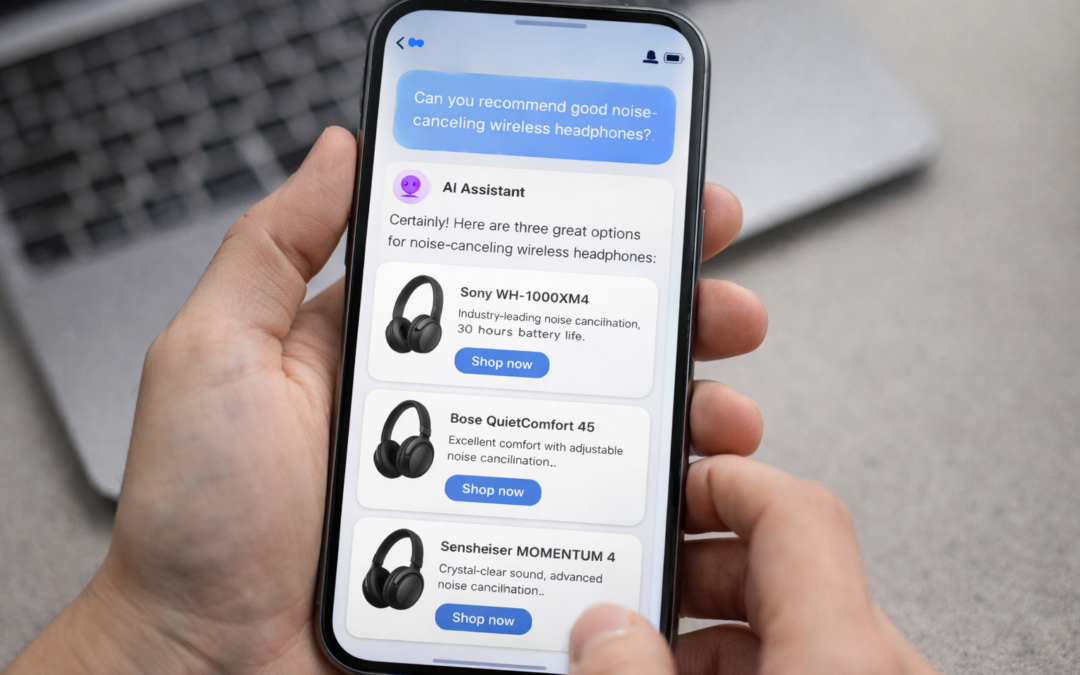
What’s happening is that consumers are starting to delegate the research, comparison and in some cases the actual purchase to AI agents. Instead of Googling “best air purifier for pet allergies under $300” and clicking through ten sites, they ask ChatGPT and get one recommendation with the option to buy it right there. Instead of scrolling through Amazon for thirty minutes, they ask Rufus and it hands them three options that match exactly what they described, and the customer picks one of the three.
There is no page two of an AI agent’s answer. The agent picks what it recommends and the other options don’t exist from the shopper’s perspective.
Most Businesses Are Invisible Right Now
In a recent analysis cited by e-commerce strategists Robert Hu and others found that only about 8% of Amazon listings have enough structured data for AI to personalize a recommendation. The other 92% are effectively invisible to Rufus because the content isn’t organized in a way the AI can understand, compare or trust.
AI agents read structured product data, machine-readable specifications, consistent pricing across sources, review signals, schema markup and clean catalog information. If your product pages have incomplete specifications, missing attributes, inconsistent pricing between your website and third-party listings, thin review content or data scattered across systems, the AI simply skips you when building its recommendation.
This applies to service businesses too. When someone asks an AI assistant for a recommendation on an AI receptionist provider in Florida, or a marine 3D printing service, or a commercial HVAC contractor, the AI is reading your website, your directory listings, your reviews, your service descriptions and your published expertise. If your content isn’t structured for machine interpretation, you’re competing with businesses that made the work easy for the AI.
The brands that win agentic commerce aren’t always the ones with the best products. They’re the ones the AI can understand, verify and confidently recommend.
The Three Protocols Driving This Forward
There are three technical standards that have quietly become the plumbing of agentic commerce in the last six months and it’s worth understanding what each one does because this is the infrastructure everything else is being built on top of.
Google’s Universal Commerce Protocol launched January 2026 with backing from Shopify, Walmart, Target, Etsy, Wayfair, Visa, Mastercard, American Express and over 20 other partners. UCP covers the entire shopping lifecycle from discovery through checkout and post-purchase support, letting AI agents complete transactions inside Search, Gemini and partner platforms without the shopper ever leaving the AI conversation.
OpenAI’s Agentic Commerce Protocol is built with Stripe and powers ChatGPT shopping through Instant Checkout. More focused than UCP on the purchase-stage transaction, ACP lets ChatGPT users buy directly from Etsy sellers and over one million Shopify merchants without leaving the chat.
Google’s Agent Payments Protocol, AP2, defines how AI agents initiate and complete payments securely on behalf of users with authorization, identity verification and audit trails. Visa, Mastercard, Affirm, PayOS and Klarna have all adopted it.
The effect of these three protocols operating together is that AI agents now have a standardized way to find products, compare options, verify claims, process payments and handle returns across the entire commerce ecosystem. This is the infrastructure phase of agentic commerce and it’s mostly built.
What This Looks Like in Practice Right Now
Amazon’s Rufus can now autonomously purchase products when prices drop to a target level a customer sets. It synthesizes reviews into summaries, handles post-purchase support including order tracking, returns and account settings without a human touching the interaction, and recommends products from non-Amazon merchants through a “Shop Direct” button that routes traffic externally.
Klarna’s AI assistant manages refunds, returns, payment issues, cancellations, disputes and invoice errors autonomously while updating customers on outstanding balances and purchase power in real time.
Google’s new Business Agent feature launching January 12, 2026 lets shoppers chat directly with brands on Google Search, with the AI handling product questions and guiding purchases.
Shopify’s Agentic Storefronts package product catalogs, checkout flows and brand information so AI platforms can present them natively inside conversations with ChatGPT, Gemini, Copilot and other assistants.
Salesforce’s Agentforce Commerce embeds autonomous agents across sales, service and marketing with early adopters reporting 20 to 40% efficiency gains in customer service through automated case routing and response generation.
The enterprise retailers and large platforms are already working inside this new reality.
Explore Our AI Solutions AI Receptionist · AI Lead Reactivation · AI Shadow Assistant · AI Voice Agent Pricing · Free Consultation
What Small Businesses Need to Do
The businesses that adapt to this now have an advantage because most of their competitors are still building strategies around traditional search and paid advertising. The window is open but it won’t stay open forever.
There are six things that matter for AI agent readiness.
The first is structured product and service data. Schema markup, complete product specifications, consistent pricing across your website and any third-party listings, accurate inventory status and clear benefit descriptions written in natural language rather than keyword-stuffed copy. AI agents read this content and score it for completeness before deciding whether to surface your business.
The second is answer-ready content. AI assistants are pulling answers from your site to respond to specific shopper questions. If someone asks an AI “which Florida AI receptionist provider works best with dental offices,” the AI is scanning content across the web looking for a clear answer. Pages that directly answer the question in plain language get cited. Pages that bury the answer under marketing copy don’t.
The third is review and trust signals. AI agents synthesize reviews and trust indicators into their recommendations. Businesses with thin review content, inconsistent ratings across platforms or unverified claims get downgraded in AI comparisons.
The fourth is the intelligence layer that connects your operation so when an AI agent drives traffic to you, your systems can handle it. There’s no point becoming AI-visible if the lead comes in at 11pm on a Saturday and nothing catches it. An AI receptionist answers every call, a lead reactivation system monitors contacts for buying signals, an onboarding workflow processes new customers automatically and a connected AI team runs the operation while the business owner sleeps.
The fifth is owning your AI infrastructure rather than renting it. If AI agents start driving 20% of your inbound leads within twelve months, you don’t want to be dependent on SaaS platforms that can change pricing, get acquired or shut down. We’ve written extensively about the SaaS model collapsing and why building on platforms you control matters more now than it did two years ago.
The sixth is testing how your business actually shows up today. Ask ChatGPT, Perplexity and Gemini about your category using the exact questions a customer would ask. If your business doesn’t surface, if competitors show up and you don’t, or if the AI gets facts wrong about you, your content isn’t ready.
The Small Business Advantage Holds Here Too
This is another area where small businesses can move faster than large enterprises and capture an opening before the bigger players finish their committee reviews.
A small business can audit its product data, restructure its catalog, rewrite its service descriptions for AI interpretation and deploy an intelligence layer to handle the resulting traffic within weeks. A large enterprise needs procurement approval, legal reviews, change management protocols, cross-department sign-offs and vendor evaluations before they can do the same work. By the time a large competitor is finished evaluating whether to start, a small business can already be visible in AI recommendations and capturing leads the competitor doesn’t know exist.
This isn’t about spending more money than the enterprise, it’s about doing the work before they do.
What Happens If You Wait
Gartner predicts 33% of enterprise applications will include agentic AI capabilities by the end of 2028, up from less than 1% today. Forrester projects that 1 in 5 B2B sellers will be compelled to respond to AI-powered buyer agents with dynamically delivered counter-offers through their own agent systems. McKinsey is projecting the agentic commerce market at $3 to $5 trillion by 2030.
This isn’t a trend you can watch from the sidelines and adopt later when it matures, because by the time it’s mature, your competitors will already have years of AI-recommendation performance data, structured content, agent-visible catalogs and connected intelligence layers working for them. Being late to agentic commerce will look a lot like being late to mobile-responsive websites in 2015 or being late to e-commerce in 2005.
The cost of starting now is modest. The cost of starting in 2028 is trying to catch up to competitors who have a three-year head start in the single largest shift in commerce since online shopping itself.
Is Your Business Ready for AI Agents?
Every week the infrastructure of agentic commerce gets more built out, more consumers delegate more decisions to AI assistants and more of the discovery and purchase journey moves out of traditional search and into AI conversations.
The businesses making this shift now are the ones that will show up when customers ask AI agents for recommendations twelve to eighteen months from now. The ones that don’t make the shift will be invisible at exactly the moment they need to be found.
If you want to walk through what AI agent readiness looks like for your specific business, what needs to change in your content, your catalog, your infrastructure and your connected AI systems, let’s setup a call.
Ready to Calculate Your AI ROI?
We built a free ROI calculator that shows you exactly what AI automation could save your business based on your actual numbers.
Explore More Insights About AI Agents & Automation
Mind2Motion.ai builds AI solutions with predictable monthly costs. You own your customizations, workflows, and integrations. Based in Palm Beach County, Florida, we serve businesses across South Florida and nationwide who want AI that works for them, not against their growth.