
Executive Summary
- Clinic operators using Mind2Motion Synapse have recovered 600 to 700 hours per year in administrative and operational time
- Lead-to-appointment workflows tightened to an average 9-minute response time, with stale leads, missed follow-ups and attribution gaps surfaced before they cost revenue
- Synapse Year 1 operating value at a multi-location clinic deployment landed in the $114,000 to $300,000 range, including lead recovery, payroll discipline, training and SOP governance, and leadership decision speed
- Staff log into one screen instead of eight or more, with role-aware workspaces for admin, clinical, providers, therapists and operations
- AI prepares the work in the background, sensitive actions stay review-first, and the deployment architecture is configured to each clinic’s environment
- Synapse is built for HIPAA compliance with deployment options ranging from on-premises hardware to managed cloud, and PHI workflows run on local AI infrastructure rather than third-party AI vendors
What Synapse Returns
Mind2Motion Synapse is the operating layer we built for clinics. It connects EHR, CRM, scheduling, billing, payroll, documents and communications into one screen, with AI running in the background to prepare the work your team would otherwise do by hand. Every role logs in once and works from one workspace shaped for what they do.
Based on our multi-location clinic deployment, the operating returns to date include the following:
- 600 to 700 hours per year recovered across administrative, payroll, and operational workflows
- 9-minute average response time on new leads, with stale leads, missed follow-ups, and source attribution surfaced automatically
- $24,000-plus in measurable lead recovery in the first year, from leads that previously fell through the cracks
- Onboarding cycle time reduced by 73% through role-specific checklists and a structured SOP sign-off workflow
- Year 1 operating value landing in the $114,000 to $300,000 range when hours recovered, lead recovery, payroll discipline, and leadership decision speed are added together
These are not pilot numbers. This is what the clinic gets in the first year of running Synapse as its daily operating screen.
If your clinic recovered 600 hours next year, where would your team put them?
One Screen, Built Around Your Roles
Most of the operational drag in a clinic does not come from any single tool, it comes from the gaps between them. The EHR holds clinical context, the CRM holds lead and follow-up state, the scheduling system holds capacity, billing holds revenue cycle, payroll holds staff hours, documents hold SOPs and training, meetings produce decisions, and somebody on your team is paid to stitch those pieces together every day. Synapse closes those gaps with a role-aware operating view that shows the work that matters to the person logging in, without the noise from every other role.
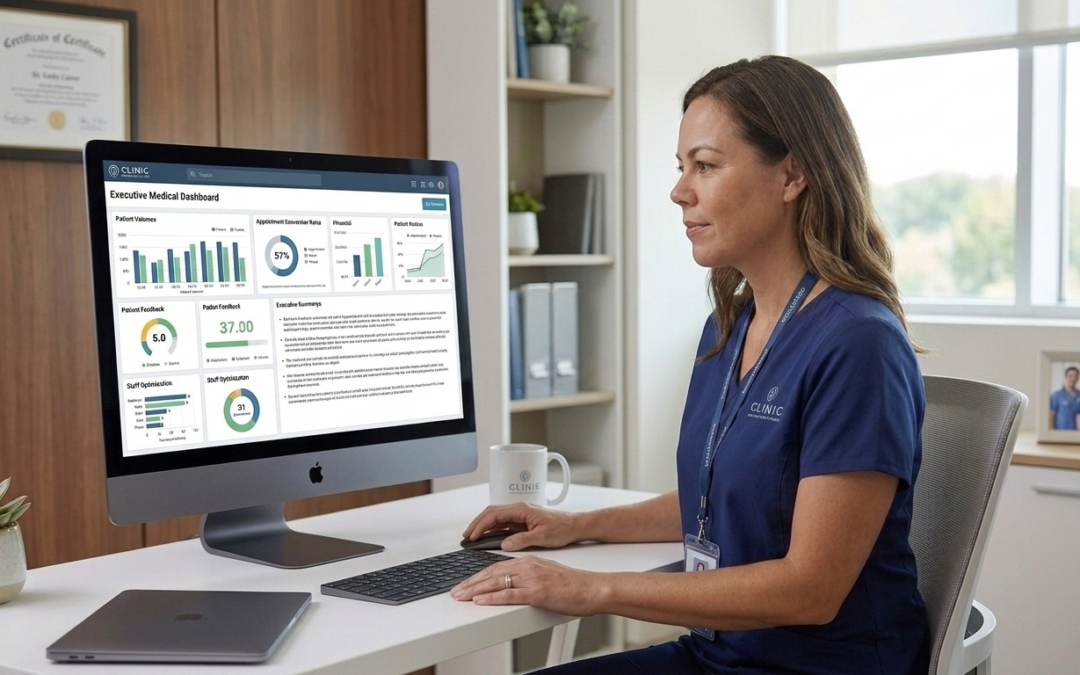
Clinic owners and operators open Synapse to a leadership view that surfaces operational health, blocked work, urgent decisions, staffing risks, and recommended next actions in one place. Admin, clinical, providers, and therapists each get a workspace shaped for the work they do, with hidden navigation for pages that do not apply to their role. You can see the full breakdown of role-aware workspaces across nine core operations workflows including executive visibility, lead intake, staff ownership, HR and SOP support, payroll, meetings, reports, AI operations assistants, and multi-clinic separation.
AI in the background summarizes meetings into action items, drafts leadership briefings, classifies and routes incoming work, surfaces blocked tasks, prepares payroll and timesheet drafts for human approval, and answers SOP and policy questions using the clinic’s own documents. Sensitive actions stay review-first, by design. The AI prepares work, a human approves it, and every change has a timestamp and an owner.
What would your day look like if the prep work was already done before you logged in?
Where does the ROI Comes From?
The 600 to 700 hours per year recovered at our multi-location clinic deployment did not come from one magic feature, it came from removing friction in workflows you already know are taking too long. The specifics worth calling out:
- Payroll review tightened from a multi-hour manual reconciliation to an AI-extracted draft that a person approves before final use, with exceptions surfaced in advance
- SOP governance moved from a folder of disconnected documents to a structured sign-off workflow with 41 indexed SOPs, review states, and a policy-aware assistant that answers staff questions in real time
- Onboarding became role-specific checklists rather than email threads passed between whoever was around that week, with credential and license expirations surfacing in advance
- Lead intake and follow-up runs as a coordinated process rather than depending on staff memory, with stale leads, no-show risks, and attribution gaps flagged automatically
- Meetings produce trackable execution rather than notes nobody reopens, with decisions, action items, owners and blockers extracted into the workspace of the person responsible
- Leadership decisions move faster because the context is already assembled, status updates stop being something you ask for and start being something you already have
Each of these is a small workflow improvement on its own. Stacked across the operating week, they compound into the hours and the recovery numbers above. Are any of these workflows ones your team currently spends real time on?
Built for HIPAA Compliance, Configured to Your Environment
Synapse is built differently than the SaaS healthcare ops products you have probably evaluated. The architecture flexes to your clinic’s compliance, security, and budget requirements. Some clinics run Synapse on dedicated on-premises hardware in their office, others deploy it in their own private cloud environment and some prefer managed cloud infrastructure that we configure for HIPAA compliance with signed Business Associate Agreements in place before any patient data moves.
In every configuration, sensitive workflows that touch protected health information run on local AI infrastructure within your environment, while non-PHI tasks use Claude API for general intelligence. Patient data is never sent to a third-party AI vendor for processing, regardless of which deployment option you pick.
Your clinic owns its data, workflows, configurations, and any custom integrations we build for you. Mind2Motion owns and maintains the underlying Synapse platform technology, with ongoing technical support and BAA coverage in place. The model is designed so the clinic is never trapped in a subscription that gets more expensive as you grow, and so the clinic always knows what is theirs and what is ours.
Explore Our AI Solutions Mind2Motion Synapse · Synapse Case Studies · AI Receptionist · AI Lead Reactivation · Free Consultation
Two Clinics, Two Different Operating Models
Two clinics are running Synapse in production today, Allay Health and Wellness and NeuPath Mind Wellness. The underlying architecture is the same, the deployments are very different, because what an operating layer actually does is shape to the practice rather than force the practice to shape to it.
At Allay, Synapse runs clinical and office operations, the HR operating system with 41 indexed SOPs in a structured sign-off workflow, payroll with AI-assisted timesheet extraction and human approval, and a leadership command view that surfaces blocked work, urgent decisions and operational risk in one screen. At NeuPath, the focus is multi-entity company separation, a performance bonus manager that tracks KPIs for the lead-handling team, scoped reporting and meetings, and executive rollup permissions for leadership operating across multiple companies.
The full operational details and outcomes for both are in the Allay and NeuPath case studies on our site. If your practice has a different operating model than either of these, that is the point. Synapse is built to fit.
How Our Process Works
Every Synapse deployment starts the same way, with a 30-minute call to understand your clinic, your stack, and your operational priorities, followed by a mapping session where we walk through how your clinic runs across intake, CRM, EHR handoffs, follow-up, reporting, staffing workflows, SOPs, meetings, and leadership visibility. At the end you receive a written Synapse report with recommended integrations and a 90-day deployment plan.
Initial workspaces typically go live within the first 30 days. Role-aware dashboards for admin, clinical, operations, and leadership get configured, core integrations connect, and AI assistants start running in the background. Broader integrations and advanced workflows roll out over the following 60 to 90 days depending on the size of your stack.
This is what we do for a living, and we would rather show you than tell you. Let us setup a call and walk through what this looks like for your practice.
Explore More Insights About AI Agents & Automation
Mind2Motion.ai builds AI solutions with predictable monthly costs. You own your customizations, workflows, and integrations. Based in Palm Beach County, Florida, we serve businesses across South Florida and nationwide who want AI that works for them, not against their growth.