
What You'll Learn
- How Amazon’s Alexa for Shopping is reshaping 250 million shopping experiences and what that means for customer expectations everywhere
- Real examples of businesses using AI to transform customer, employee, and vendor interactions
- Why 82% of small businesses have already invested in AI tools and what they’re doing with them
- The specific use cases driving measurable ROI across operations, sales, and service
- How to identify the right starting point for your business
Amazon’s Alexa for Shopping formally Rufus handled 274 million queries per day last fall and customers who interact with it convert 60% better than those who don’t with the company adding $10 billion in gross merchandise volume just from that one AI assistant.
Walmart partnered with Google’s Gemini to bring AI across their entire shopping experience and 82% of small business employers have now invested in AI tools according to the SBE Council’s 2026 survey, with the average company running five different AI systems across their operations.
You might be asking yourself, ok, so how should we integrate this technology in our business?
The Shift Is Happening
For years, AI in business meant chatbots that frustrated customers and automation that broke more than it fixed.
The shift happening right now is from AI that assists to AI that executes. Instead of suggesting a refund policy or recommending a next step, systems can now verify eligibility, initiate the transaction, update the records and notify the customer without anyone touching it.
A bakery owner in the Midwest was spending 8-10 hours per week on social media, photographing products, writing captions, scheduling posts, responding to DMs. She was also throwing away $400-$600 per week in unsold bread because production was based on gut feeling. Now AI handles the content while a simple forecasting system tells her exactly how much to bake each day and the tools cost her about $50 per month.
A law firm automated their intake process. An AI chatbot qualifies cases 24/7 based on the firm’s criteria, schedules consultations for qualified leads and sends polite referrals to everyone else. For cases that move forward, AI pre-populates the intake forms, engagement letters and records authorizations. The paralegal reviews and finalizes instead of creating from scratch.
A solo real estate agent was spending 3-4 hours per listing on marketing materials and another 5-8 hours per week on lead follow-up. Now AI generates the property descriptions, social posts, email campaigns and follow-up sequences while she focuses on the work that requires her expertise.
What would your team do with an extra 10 hours per week?
Where This Is Working
The businesses seeing the biggest impact aren’t trying to automate everything at once, they are picking one high-friction workflow and building from there.
Customer-facing operations are the most common starting point. AI handling routine inquiries means your team only deals with the conversations that need them. The best implementations are deflecting 50-70% of support volume while customer satisfaction scores go up, not down, because response times drop from hours to seconds.
Lead intake and qualification is another high-value area. Instead of someone manually reviewing every form submission, AI can score leads against your criteria, route qualified opportunities to the right person and respond to everyone else with appropriate next steps. The leads that matter get attention faster while the tire-kickers get handled automatically.
Internal operations often have the highest ROI but get overlooked. Invoice follow-up, appointment confirmations, inventory alerts, status updates to vendors, onboarding sequences for new employees, these are the tasks that eat hours every week but don’t feel urgent enough to fix. Until you add them up and realize your team is spending 30% of their time on work that could run itself.
Post-sale experience is where customer retention lives. Proactive check-ins, usage-based recommendations, renewal reminders, feedback collection, all of this can happen automatically based on where each customer is in their journey. A local retailer set up a system where customers who bought running shoes in January automatically get relevant content about spring gear in March, no manual work after the initial setup.
The pattern is consistent: start with something specific, measure the impact, expand from there.
Why the "Stack" Approach Is Winning
The SBE Council survey found that the typical small business is now using five AI tools in combination. Not because they’re trying to be cutting-edge, but because different tools solve different problems.
One for customer communication, one for content creation, one for workflow automation, one for scheduling and coordination and one for data analysis and reporting.
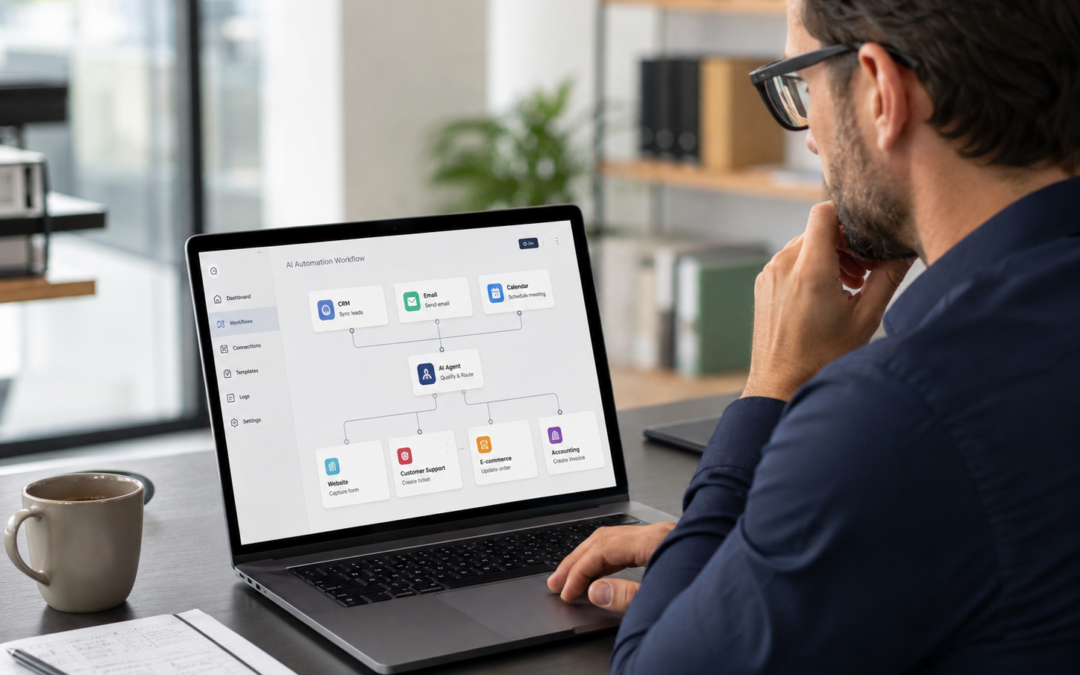
The businesses getting results aren’t looking for one magic solution, they are building a system where AI handles the connective tissue between their existing tools and processes. HubSpot talks to the calendar system which triggers the onboarding sequence which updates the project board which notifies the right person when action is needed.
The intelligence layer sits on top of tools you already use and It doesn’t have to necessarily replace your CRM or your project management software or your accounting system. It makes them work together in ways they couldn’t before.
That’s the work we do at Mind2Motion. We look at your operations, identify where the friction lives, and build the automation that connects everything. You keep your existing tools, you own the systems we build, and the efficiency compounds over time.
The Cost of Waiting
Here’s what’s happening while businesses sit on the sidelines: customer expectations are calibrating to the companies that are moving.
When someone gets an instant, helpful response from one business, they notice when another business takes two days to reply. When a vendor proactively flags an issue before it becomes a problem, the vendors who only respond to complaints look outdated. When a competitor’s sales process feels effortless because AI is handling the coordination, your manual process feels like friction.
93% of small businesses using AI plan to continue investing in it and 62% say they’re increasing their AI spending this year. The companies that build these capabilities now aren’t just capturing efficiency gains today, they’re building institutional knowledge about what works for their specific customers and operations.
That knowledge compounds and the businesses that start now will be further ahead next year than the ones who wait.
Explore Our AI Solutions AI Receptionist · AI Lead Reactivation · AI Shadow Assistant · AI Voice Agent Pricing · Free Consultation
Where to Start
If you’re looking at your operations wondering which use case makes sense first, here’s the filter we use with clients:
Find the workflow that eats the most hours and follows predictable patterns. Lead intake, customer support, appointment coordination, invoice follow-up, status updates, these are usually good candidates because they’re high-volume, repetitive, and have clear rules for how they should work.
The setup isn’t as complicated as it sounds. Most implementations we build are running within a few weeks, not months. And the ROI typically shows up in the first billing cycle because you’re addressing a pain point that already exists.
If you want to talk through what this might look like for your business, we’re happy to walk through it. No pressure, just a conversation about where the opportunity lives and what makes sense given where you are right now.
Ready to Calculate Your AI ROI?
We built a free ROI calculator that shows you exactly what AI automation could save your business based on your actual numbers.
Explore More Insights About AI Agents & Automation
Mind2Motion.ai builds AI solutions with predictable monthly costs. You own your customizations, workflows, and integrations. Based in Palm Beach County, Florida, we serve businesses across South Florida and nationwide who want AI that works for them, not against their growth.